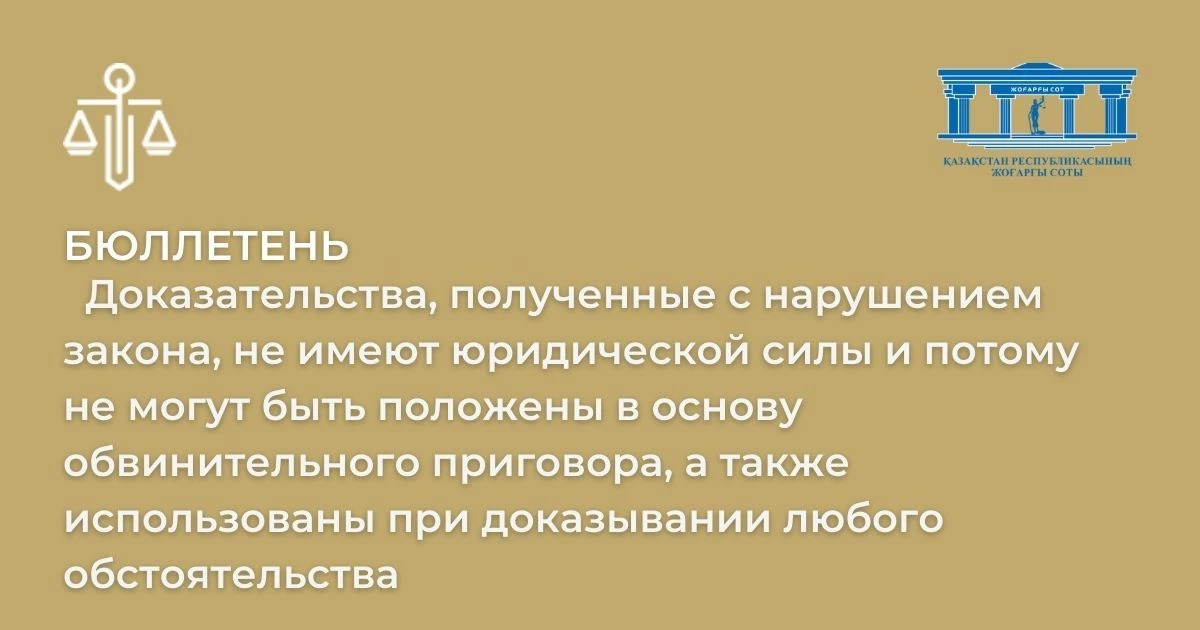
Evidence obtained in violation of the law has no legal force and therefore cannot be used as the basis for a guilty verdict, as well as used in proving any circumstance.
By the verdict of the court No. 2 of the city of Taraz, Zhambyl region, dated May 6, 2020: O., who had no previous convictions, was acquitted under part 1 of Article 297, part 4 of Article 296 of the Criminal Code of the Republic of Kazakhstan (hereinafter referred to as the Criminal Code) for the lack of evidence of his involvement in the commission of criminal offenses. O. was charged by the pre-trial investigation body with illegal acquisition, possession for the purpose of selling and marketing narcotic drugs, as well as illegal possession without the purpose of selling narcotic drugs on an especially large scale. By a decision of the judicial board for Criminal Cases of the Zhambyl Regional Court dated July 27, 2020, at the appeal and private request of the prosecutor, the verdict of the court under part 1 of Article 297 of the Criminal Code was canceled due to the one-sidedness and incompleteness of the judicial investigation, the verdict regarding the acquittal of O. under part 4 of Article 296 of the Criminal Code remained unchanged. By the verdict of the judicial board for criminal cases of the Zhambyl Regional Court dated September 3, 2020, O. was sentenced under part 5 of Article 28, part 2 of Article 296 of the Criminal Code to a fine of 80 MCI in the amount of 202 000 tenge. In accordance with the requirements of part 3-1 of Article 62 of the Criminal Code, the time of O.'s detention from September 17, 2019 to May 6, 2020 was calculated as the amount of the fine based on one day of detention for four monthly calculation indices and it was decided to consider the imposed penalty in the form of a fine executed. In the petition, lawyer K. indicates the illegality and inadmissibility of the results of secret investigative actions obtained by conducting a control purchase, the absence of instructions from the investigator to the body of inquiry to conduct a secret control purchase of narcotic drugs, to seize packages from a conditional buyer without the participation of witnesses and proper video recording.
Evidence obtained in violation of the law has no legal force and therefore cannot be used as the basis for a guilty verdict, as well as used in proving any circumstance.
He claims that the witness, under the pseudonym "Vitaly," is a guy named "Dilshot," who, with his brother "Daulet," provoked and forced O. to transfer bundles of narcotic drugs. The lawyer also disagrees with the composition of the court, which considered the case according to the rules of the court of first instance, which took part in the consideration of the prosecutor's appeal, and therefore asks to acquit O. In accordance with paragraphs 1, 3) of Article 485 of the Criminal Procedure Code of the Republic of Kazakhstan (hereinafter referred to as the CPC), the grounds for cassation review of judicial acts that have entered into force are the improper application of criminal and criminal procedure laws and the conviction of an innocent person. The verdict of the court of appeal was based on O.'s testimony about the transfer of a package of narcotic drugs and a video recording of a control purchase dated September 11, 2019, indicating in the verdict that the court of first instance had not given an appropriate assessment of this evidence. As can be seen from the case materials, the criminal prosecution body committed significant violations of the norms of the criminal procedure law during the pre-trial investigation, which entail the recognition of a number of evidence collected in the case as inadmissible. In accordance with part 2 of Article 232, part 3 of Article 196 of the CPC, covert investigative actions, with the exception of covert control of postal and other items, are carried out on behalf of the pre-trial investigation body by an authorized unit of a law enforcement or special state body using forms and methods of operational investigative activities. The body of inquiry may carry out secret investigative actions only on the instructions of the investigator. It also follows from the provisions of the Law of the Republic of Kazakhstan dated September 15, 1994 No. 154-XIII "On operational search activities" that the operational purchase of narcotic drugs or psychotropic substances, their analogues and other operational search activities are carried out only if there are grounds provided by law for their conduct.
By studying the materials of the criminal case, it was established that by the order of September 5, 2019, investigator P. entrusted the body of inquiry with conducting covert investigative actions against O. in the form of covert audio and video monitoring of a person or place, covert surveillance of a person or place, and covert introduction and imitation of criminal activity. However, Taraz M., an operative of the Criminal Police Department of the city of Taraz, who was instructed by the investigator to carry out secret investigative actions, issued a decision to conduct an unspoken control purchase, which was not provided for in the investigator's instructions. In violation of the above-mentioned norms, on September 11, 2019, the body of inquiry conducted a secret control purchase of narcotic drugs from O., thereby operative M. exceeded his official powers granted to him by the current legislation and carried out investigative actions not specified in the investigator's instructions. It follows from the testimony of witness P. that during the pre-trial investigation he did not give instructions to the body of inquiry to conduct a secret control purchase of narcotic drugs. According to paragraph 13 of the regulatory resolution No. 5 of the Supreme Court of the Republic of Kazakhstan dated December 20, 2020 "On the practice of authorizing secret investigative actions", the executor of a secret investigative action does not have the right to conduct another secret investigative action not specified in the instruction. If the contractor went beyond the scope of the assignment given to him during the secret investigative action, then the information obtained as a result of their conduct cannot be recognized as evidence in the case. These circumstances served as the basis for the Court of first instance to recognize the investigative actions for the secret control purchase of narcotic drugs on September 11, 2019 as illegal, and the results obtained as inadmissible as evidence and for the acquittal of O. under part 1 of Article 297 of the Criminal Code. The Judicial Board for Criminal Cases of the Zhambyl Regional Court, canceling the acquittal of the court of first instance under part 1 of Article 297 of the Criminal Code, did not take into account the requirements of paragraph 19 of the normative resolution of the Supreme Court of the Republic of Kazakhstan dated April 20, 2018 No. 4 "On the court verdict", according to which, when assessing evidence, courts should be guided by the provisions set out in subparagraph 9) of paragraph 3 of Article 77 of the Constitution, articles 112 and 125 of the CPC, stating that evidence obtained in violation of the law, They have no legal force and therefore they cannot be used as the basis of a guilty verdict, as well as used in proving any circumstance specified in article 113 of the CPC.
It follows from O.'s testimony that he was provoked and incited to commit illegal acts by brothers named "Daulet" and "Dilshot", who had been temporarily renting a temporary house from his housemate since August 25, 2019 and asked for help to purchase anasha. They called him every day from September 5 to September 11, 2019 with this request, and then "Daulet" asked him to give his brother a package, the contents of which he did not open. As it was established from the details of the phone calls, the witness under the pseudonym "Vitaly" called the defendant 15 times from September 5 to September 11, 2019, which refutes the testimony of "Vitaly" that he did not know O. and did not call him. From the video recording of the voluntary delivery of narcotic drugs by a witness under the pseudonym "Vitaly" to police officers, it is clear that not all actions of police officers and the witness during the commission of actions for the secret control purchase of narcotic drugs were recorded on camera, namely: the moment of sealing the seized substances was not filmed. In addition, Fr. The funds used in the control purchase were not withdrawn. In this regard, the court gave a critical assessment of the truthfulness of the testimony of the witness under the pseudonym "Vitaly". Apart from the testimony of a witness under the pseudonym "Vitaly", the veracity of which is questionable, and the evidence of the investigation into the secret control purchase of narcotic drugs on September 11, 2019, which was recognized as inadmissible, there is no other relevant and admissible evidence in the case. In such circumstances, the judicial board considers that the verdict of the court of first instance on the acquittal of O. it is legitimate and justified. Based on the above, the judicial board of the Supreme Court for Criminal Cases annulled the judicial acts of the appellate instance against O. The acquittal verdict of the court of first instance against O. remained unchanged. The submission of the Chairman of the Supreme Court of the Republic of Kazakhstan is satisfied.
Attention!
Law and Law Law Law draws your attention to the fact that this document is basic and does not always meet the requirements of a particular situation. Our lawyers are ready to assist you in legal advice, drawing up any legal document suitable for your situation.
For more information, please contact a Lawyer / Attorney by phone: +7 (708) 971-78-58; +7 (700) 978 5755, +7 (700) 978 5085.
Attorney at Law Almaty Lawyer Legal Services Legal Advice Civil Criminal Administrative Cases Disputes Protection Arbitration Law Firm Kazakhstan Law Office Court Cases