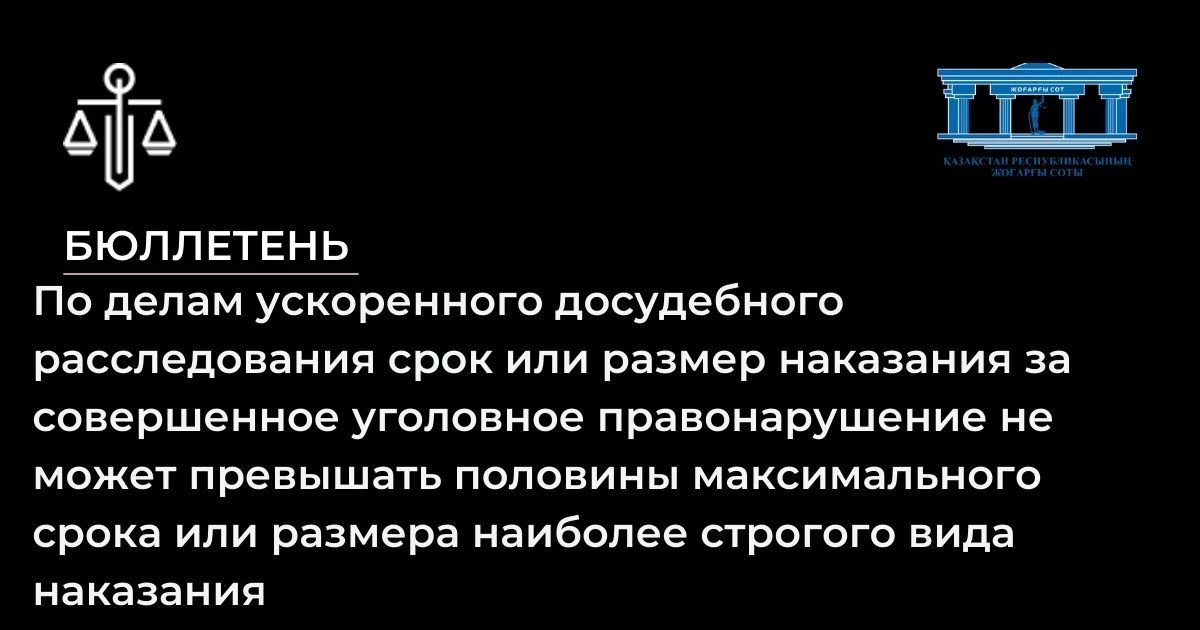
In cases of accelerated pre-trial investigation, the term or amount of punishment for a committed criminal offense may not exceed half of the maximum term or amount of the most severe type of punishment.
By the verdict of the Kordai District Court of Zhambyl region dated April 21, 2015, K., who had no previous criminal record, was sentenced under paragraph 5) of part 2 of Article 286 of the Criminal Code of the Republic of Kazakhstan (hereinafter referred to as the Criminal Code) to 7 years in prison, and under part 3 of Article 296 of the Criminal Code to a fine of 100 monthly calculation indices. Based on part 3 of Article 58 of the Criminal Code, by absorbing a less severe punishment, a more severe one was finally imposed in the form of 7 years of imprisonment to be served in a general regime penal colony. The verdict was not reviewed on appeal. By the Court of K. He was found guilty that on March 25, 2015, while on the territory of the Kyrgyz Republic, near the Akzhol customs post, he illegally purchased from an unidentified person and stored a large–scale narcotic substance, heroin, weighing 0.770 grams, for personal use without the purpose of sale. On the same day, after crossing the state border of the Republic of Kazakhstan, K. was detained by officers of the Department of Internal Affairs of the Kordai district, and the above-mentioned narcotic drug was found under his sweater collar. In the protest, the Prosecutor General, without disputing the evidence of K.'s guilt, and the correctness of the qualification of his actions indicates that the court's verdict is subject to change due to a violation of the requirements of the General Part of the Criminal Code, which resulted in an incorrect imposition of punishment.
Requests the court's verdict to be changed: on the basis of part 3 of Article 55 of the Criminal Code, the sentence imposed under paragraph 5) of part 2 of Article 286 of the Criminal Code to be reduced to 6 years in prison, on part 3 of Article 296 to remain unchanged, on the basis of part 3 of Article 58 of the Criminal Code to finally impose a sentence of 6 years in prison. Based on the provisions of the Constitution of the Republic of Kazakhstan on the equality of all before the law and the court, no one can be found guilty of committing a criminal offense and subjected to criminal punishment except by a court verdict that has entered into force. The guilt of the convicted K. The commission of a crime under the circumstances specified in the court verdict was established by the factual data collected in the case, including the confessions of the convict himself, in which he fully admitted guilt, and an expedited pre-trial investigation was conducted in connection with this. K.'s actions were given a correct legal assessment by the court. At the same time, the criminal law was incorrectly applied by the lower courts when imposing the punishment measure on K.. In accordance with part 3 of Article 55 of the Criminal Code, in cases of accelerated pre-trial investigation, the term or amount of punishment for a committed criminal offense may not exceed half of the maximum term or amount of the most severe type of punishment provided for in the relevant article of the Special Part of the Criminal Code. The maximum penalty (5) of Part 2 of Article 286 of the Criminal Code provides for 12 years of imprisonment. Taking into account part 3 of Article 55 of the Criminal Code, the court should have sentenced K. to half of the maximum sentence – 6 years in prison, not 7 years. When assigning the final punishment to K. On the basis of article 58 of the Criminal Code, the court applied the principle of absorbing a less severe punishment with a more severe one, and therefore the final punishment could not exceed 6 years. Based on the above, the Judicial Board for Criminal Cases of the Supreme Court changed the verdict of the court of first instance in relation to: - with the application of part 3 of Article 55 of the Criminal Code, the sentence under paragraph 5) of part 2 of Article 286 of the Criminal Code was reduced to 6 years in prison; - the sentence imposed on him under part 3 of Article 296 of the Criminal Code remained unchanged; - on the basis of part 3 of Article 58 of the Criminal Code, K. was finally sentenced to 6 years of imprisonment with serving his sentence in an institution of the medium-security penal system for a combination of crimes by absorbing a less severe punishment with a more severe one; - the rest of the sentence was left unchanged, the protest of the Prosecutor General of the Republic of Kazakhstan was satisfied.
Attention!
Law and Law Law Law draws your attention to the fact that this document is basic and does not always meet the requirements of a particular situation. Our lawyers are ready to assist you in legal advice, drawing up any legal document suitable for your situation.
For more information, please contact a Lawyer / Attorney by phone: +7 (708) 971-78-58; +7 (700) 978 5755, +7 (700) 978 5085.
Attorney at Law Almaty Lawyer Legal Services Legal Advice Civil Criminal Administrative Cases Disputes Protection Arbitration Law Firm Kazakhstan Law Office Court Cases
Download document
-
По делам ускоренного досудебного расследования срок или размер наказания за совершенное уголовное правонарушение не может превышать половины максимального срока или размера наиболее строгого вида наказания
2360 downloads -
По делам ускоренного досудебного расследования срок или размер наказания за совершенное уголовное правонарушение не может превышать половины максимального срока или размера наиболее строгого вида наказания
2288 downloads