
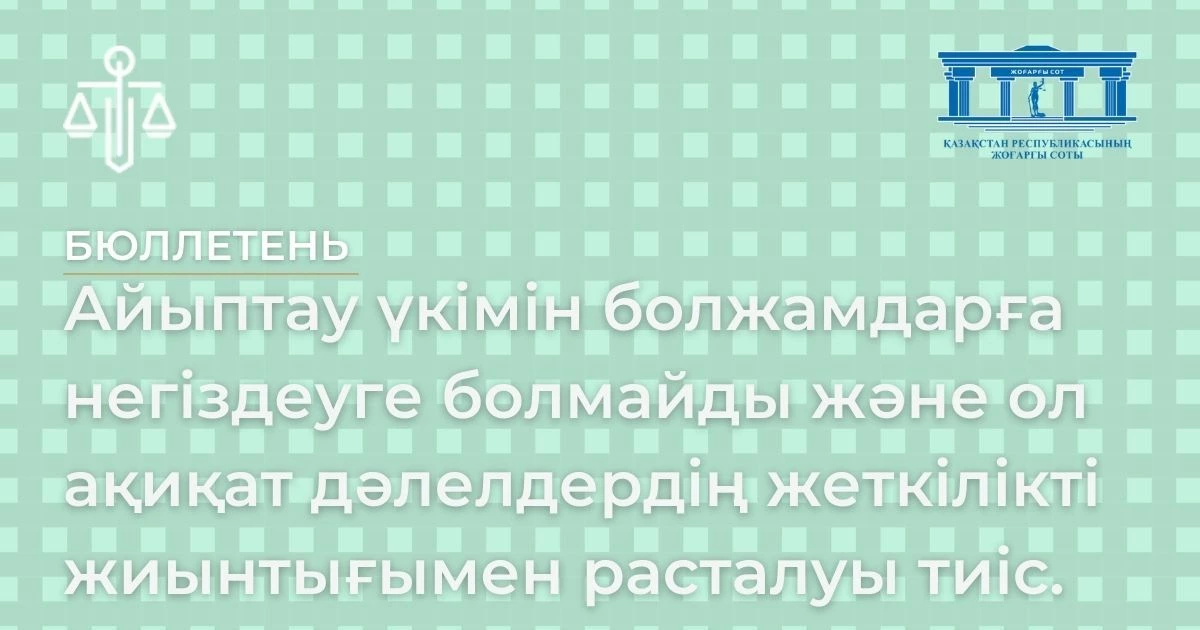
A guilty verdict cannot be based on assumptions, and it must be supported by a sufficient set of true evidence.
By the verdict of the Mangistau District Court of Mangistau region dated April 17, 2012: D. not previously convicted, sentenced to 3 years in prison under Paragraph "A" of Part 2 of Article 175 of the Criminal Code of the Republic of Kazakhstan (hereinafter referred to as the Criminal Code), serving a sentence in the general regime of a correctional colony. In favor of the victim zh. 324,000 tenge was collected from the convicted G., in favor of the state-3,240 tenge. Convicted by a court verdict, G. was found guilty of the secret theft of other people's property by a preliminary conspiracy of a group of people. By the decisions of the Appellate Judicial Board of the Mangistau Regional Court dated May 17, 2012 and the Cassation judicial board dated January 23, 2013, the court's verdict was left unchanged. In his appeal, the convicted G. partially disagreed with the court's decisions, said that gross violations of the requirements of the law were allowed, the court sentence was aimed at one-sided prosecution, he committed the crime alone, fully compensated for the damage caused to the victim, re-qualified his actions with Part 1 of Article 175 of the criminal code and asked to impose a suspended sentence without deprivation of Liberty. The supervisory judicial board hears the opinion of the prosecutor asking to reduce the sentence to 2 years and 4 months, differentiating the criminal actions of the convicted G. Part 1 of Article 175 of the criminal code, examines the case documents and the arguments presented in the application, considers that judicial acts are subject to change on the following grounds.
The guilt of the convicted G. for theft was investigated in the judicial investigation and found a complete proof with a set of evidence objectively assessed by the court of First Instance. In particular, along with the answer of the convicted G., The answer given by the victim G. at the main trial, the inspection of the scene of the criminal incident, its photo report, protocols for obtaining, examining and registering evidence in the case, conducting an inspection of Housing and a set of other evidence are fully clarified and approved. According to the documents of the criminal case, the victim is zh. in the main trial, it was stated that a single person would not have the strength to slaughter one horse. And the witness said that during the investigation, on the day of the crime, he saw two strangers heading to the mountains at a distance of 500 meters. In accordance with this answer, the court concluded that G. committed a crime according to the preliminary conspiracy of a group of people. But at the trial, the witness T. was not questioned. And the convicted G., during the preliminary investigation and trial, answered unequivocally that he alone committed the crime. According to the documents of the criminal case, it has not been proven that he committed a crime by prior collusion with a group of other persons. Therefore, due to the above circumstances, the court incorrectly ranked the criminal actions of the convicted G. in Paragraph "A" of Part 2 of Article 175 of the criminal code. According to the requirements of Article 117 of the code of criminal procedure, the event and the signs of the corpus delicti provided for by the criminal law in the criminal case (time, place, method and other circumstances of the commission of the crime) are subject to mandatory proof. Articles 278 and 379 of this code indicate that the indictment and the descriptive-reasoned parts of the guilty verdict must contain a description of the criminal act. According to Part 4 of Article 19 of the code of criminal procedure, a guilty verdict cannot be based on assumptions, and it must be confirmed by a sufficient set of truthful evidence. However, the court, as indicated in the verdict, relied only on the victim's answer, that is, it considered the case unilaterally and based the verdict on assumptions. Actions aimed at fulfilling these requirements of the law were not carried out by the appellate and Cassation courts. Therefore, in the judicial acts issued against G., It was negatively concluded that he committed the crime by prior collusion of a group of people. In connection with the above - mentioned grounds, the supervisory judicial board amended the judicial acts against D., re-differentiating his actions from Paragraph "A" of Part 2 of Article 175 of the Criminal Code to Part 1 of Article 175 of the criminal code and imposing a sentence of 2 (two) years 4 (four) months of imprisonment under this article.
Назар аударыңыз!
«Заң және Құқық» адвокаттық кеңсесі, бұл құжаттың жалпылама екендігіне және нақты сіздің жағдайыңыздың талаптарына сәйкес келмеуі мүмкіндігіне көңіл бөлуіңізді сұрайды. Біздің заңгерлер сіздің нақты жағдайыңызға сәйкес келетін кез келген құқықтық құжатты әзірлеп көмектесуге дайын.
Қосымша ақпарат алу үшін Заңгер/Адвокат телефонына хабарласуыңызға болады: +7 (708) 971-78-58; +7 (700) 978 5755, +7 (700) 978 5085.
Адвокат Алматы Заңгер Қорғаушы Заң қызметі Құқық қорғау Құқықтық қөмек Заңгерлік кеңсе Азаматтық істері Қылмыстық істері Әкімшілік істері Арбитраж даулары Заңгерлік кеңес Заңгер Адвокаттық кеңсе Қазақстан Қорғаушы Заң компаниясы
